The Science of Why You Can't Stop Scrolling
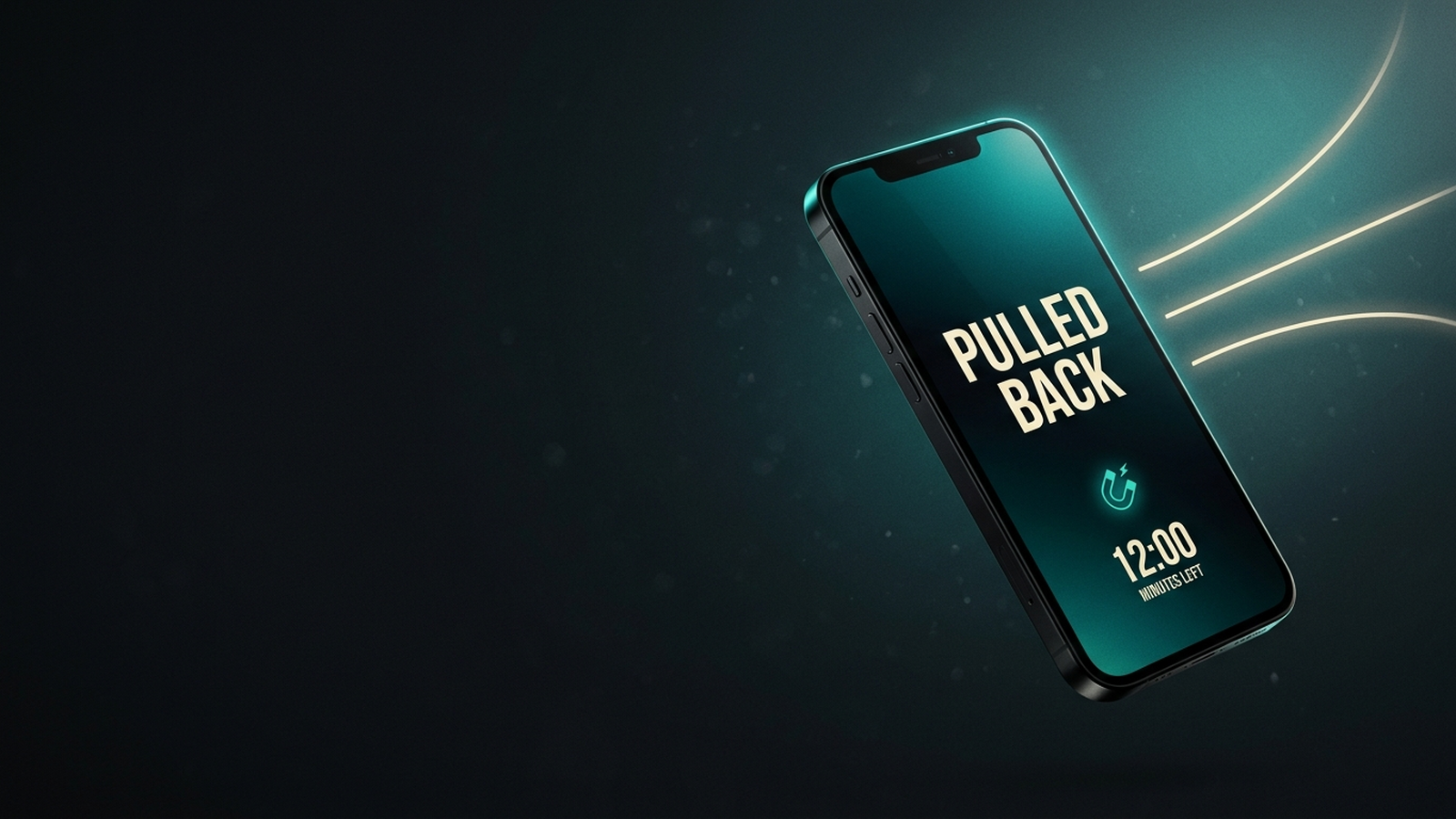
You're not weak. The feed is engineered, by people with PhDs, to keep you in the zone. If you've ever opened Instagram to check one notification and surfaced forty minutes later with no memory of the intervening time, what you experienced wasn't a personal failure — it was a well-documented behavioral mechanism working exactly as designed.
This post walks through the actual research: how slot-machine mechanics migrated into your pocket, why your time perception fails during passive scrolling, what happens in your brain during an infinite-scroll session, and where the evidence points for breaking the loop. PullBack is built on this science — specifically, on the finding that the easiest place to interrupt a doomscroll is during it, not before.
The Slot-Machine Mechanic in Your Pocket
Anthropologist Natasha Dow Schüll spent fifteen years embedded in the Las Vegas gambling industry and documented in Addiction by Design (Princeton, 2012) how machine designers explicitly engineer "the zone" — a dissociative trance where players lose track of time, money, and bodily needs.
The parallels between slot machines and infinite-scroll feeds aren't metaphorical. They're architectural. Schüll's fieldwork revealed that modern slot machines are deliberately designed to maximize "time on device" — not to make players win, but to keep them playing. The ergonomic seating, the rhythmic sound design, the near-miss programming, and most importantly, the variable-ratio reward schedule all serve one purpose: maintaining the zone.
Social media apps use the same toolkit. Pull-to-refresh is the lever pull. Algorithmically-curated content is the reward, delivered after an unpredictable number of swipes. The seat is your couch; the sound design is your notification chime. The goal is identical: keep you in the zone as long as possible. The difference is that slot machines are regulated. Your feed is not.
Variable-Ratio Reinforcement: The Addiction Engine
B.F. Skinner identified the variable-ratio schedule — rewards delivered after an unpredictable number of responses — as the most resistant-to-extinction reinforcement schedule he tested in the operant conditioning chamber, which is why slot-machine designers and feed engineers both gravitate toward it.
In a fixed-ratio schedule, you know exactly how many lever presses yield a reward. You work efficiently, collect your payout, and leave. In a variable-ratio schedule, the reward is unpredictable. Maybe the next swipe is the one. Maybe the one after that. The uncertainty itself becomes the hook — it creates a sustained seeking state that outlasts any fixed schedule.
The neurochemistry behind this is widely misunderstood. Dopamine is not a pleasure chemical; it's a wanting signal. Kent Berridge's incentive-salience research clarified this distinction: dopamine drives pursuit, not enjoyment. That's why doomscrolling can feel both wired and joyless simultaneously — your brain is chasing, not savoring. Noradrenaline handles the arousal and vigilance, which explains the jittery, can't-stop-now feeling.
The feed doesn't need to make you happy. It just needs to keep you seeking. Variable-ratio reinforcement is the most efficient way to do that, and it's not an accident that every major platform uses it. Here's how to interrupt it without relying on willpower.
Time Blindness: Why 5 Minutes Feels Like 30
Rivkin and Bouwer (2018) demonstrated experimentally in the Creativity Research Journal that moderate attentional demand produces downward time distortion — the subjective experience that far less time has passed than actually has.
Mihaly Csikszentmihalyi's flow research identified "transformation of time" as one of nine core characteristics of deep absorption. During flow states, subjective time compresses or stretches unpredictably. Doomscrolling isn't classical flow — you're not developing skill or experiencing challenge-skill balance — but the time-distortion mechanism is the same. Your attention is fully occupied by low-demand, high-novelty stimulus, and your internal clock stops ticking.
The smartphone-specific research is even more striking. Andrews et al. (2015) found that participants systematically underestimated their actual screen time, and a 2023 study found the average underestimate during lockdown was roughly 71 minutes per day. A meta-analysis of self-reported vs. logged screen time found that only 3 of 49 comparisons placed self-reports close to objectively measured means. People are not lying; they're genuinely unable to perceive duration accurately during passive scrolling.
This is why "just be aware of your usage" is bad advice. Awareness doesn't work when the mechanism you're trying to be aware of actively suppresses awareness. You need an external timer because your internal one is offline. For people with ADHD, the effect is even more pronounced.
The Neuroscience of the "Infinite Scroll" Trance
Schüll's participants in the zone described a state of "suspended animation" where self-awareness, bodily needs, and future planning all receded — a dissociative state that shares features with what TikTok and Reels users report during extended sessions.
The infinite-scroll trance has three components. First, continuous partial attention — you're never fully focused, but never fully disengaged. The feed keeps you in a liminal state where switching costs feel low (just one more swipe) but accumulate invisibly. Second, intermittent variable rewards — the occasional viral video, the unexpected message, the funny comment — which maintain dopaminergic pursuit without satiation. Third, bottomless design — there's no natural endpoint, no page break, no loading screen that invites reflection.
Together, these three components produce what researchers call a "sticky" environment: one that resists exit not through explicit barriers, but through the absence of exit cues. You don't decide to keep scrolling; you fail to decide to stop. The default action — another swipe — is frictionless. The non-default action — closing the app — requires an active decision that your depleted prefrontal cortex is poorly equipped to make.
What the Research Says About Breaking the Loop
Löchner et al. (2023), "Directing smartphone use through the self-nudge app one sec," PNAS, 120(8), e2213114120 — a 6-week field experiment with 280 participants found that pre-open friction with an easy bail-out reduced app openings 57%, with the dismiss option driving the strongest effect, not the deliberation message.
The PNAS study is the most rigorous recent evidence for friction-based interventions. Here's what actually happened: participants installed an app that inserted a brief pause before target apps opened. The pause included a time delay, a deliberation message, and a dismiss option. After six weeks, app openings were down 57% and attempted openings were down 37%.
But the mechanism decomposition is what matters. A preregistered follow-up (N=500) found that the option to dismiss drove the strongest effect. The time delay produced a smaller but real reduction. The deliberation message — the mindfulness sentence — did basically nothing. "Friction works" is true, but the specific friction that works is the easy exit, not the preachy prompt.
Other RCTs have shown smaller and less consistent results. A 2025 npj Mental Health Research trial found that limiting digital screen use improved well-being and mood; nudge-based RCTs have shown effects ranging from null to roughly 29 minutes per day reduction on the most problematic app. Effect sizes vary; the design and the user's pre-existing motivation matter. The research supports the category, not every implementation.
The Mid-Session Interrupt: A Design-Backed Escape
Psychological reactance theory (Brehm, 1966; Steindl et al., 2015) predicts that restricting freedom motivates its restoration — which is why hard blockers produce uninstalls, and why mid-session interrupts that preserve entry freedom avoid the reactance trap entirely.
PullBack's mechanism is simple: let the user in, then end the session when a timer runs out. When time is up, PullBack shows its pull-back screen and returns you to your home screen. The first two lockout screens offer a 30-second extension; after that, the session ends. This isn't willpower. It's design. The user has already self-permitted by opening the app, so there's no fight about whether they're allowed in. The interrupt only restricts session length — the part the user never consciously chose.
The timing is the key. Pre-open friction trains habituation because it fires at the same moment every time. Hard blocks trigger reactance because they restrict access. A mid-session interrupt fires after self-permission but before the variable-reward schedule has done most of its damage. It's the only window where the behavioral economics work in your favor.
We're honest about the limits. No replication study yet validates the mid-session variant specifically. The theoretical basis is solid — the PNAS dismiss-option finding, the reactance literature, the habituation research — but the exact timing and implementation are our own design. If the research evolves, we'll update. We'd rather be corrected than wrong. Here's how Instagram's design specifically exploits these mechanisms.
Frequently Asked Questions
Is doomscrolling actually addictive?
"Addiction" is a clinical term. Doomscrolling fits some criteria — compulsive use, continued use despite negative consequences, difficulty stopping — but the research uses terms like "problematic smartphone use" or "compulsive use" more carefully. The 2022 Doomscrolling Scale defines it as habitual, immersive scanning for negative information. It's a real, measurable construct with replicated mental-health correlations.
Why does time pass so quickly when I'm scrolling?
Downward time distortion during absorbing activity is well-documented. Your internal clock relies on attentional resources, and when those resources are fully occupied by novel stimulus, time estimation collapses. A 2023 study found people underestimate screen time by 71 minutes per day on average.
Does deleting social media apps solve the problem?
For some people, yes. For others, deletion triggers cycles of reinstalling and re-deleting. The research on abstinence approaches is mixed: some studies show mood improvements after one week off, but effect sizes are modest and attrition is high. A mid-session interrupt preserves access while limiting the problematic behavior pattern — the extended, unintentional binge.
Can I train myself to be more aware of my scrolling?
The evidence for mindfulness-based approaches to screen time is weak. The PNAS study found that deliberation messages alone did basically nothing. Time perception during passive scrolling is genuinely impaired; asking someone to "be aware" is asking them to perceive something perception is bad at. A timer does the noticing for you.
Is the dopamine explanation oversimplified?
Yes, in pop science. Dopamine is primarily a "wanting" signal, not a pleasure signal. The actual neurochemistry involves multiple systems: dopamine for pursuit, noradrenaline for arousal, and endogenous opioids for the occasional actual enjoyment. "Dopamine detox" is a wellness cliché; the real picture is more complex and more interesting.
What makes PullBack different from just using a timer?
A kitchen timer requires you to notice it, decide to act, and then actually close the app. By the time you've made those three decisions, you've probably swiped five more times. PullBack automates the exit — no decision, no willpower, no opportunity to negotiate with yourself. See how it works.
Dig Deeper
The feed isn't going to become less engineered. Billion-dollar optimization budgets ensure that. What you can change is whether you have an external stop signal that fires before the trance gets long.
PullBack is that signal. Not willpower. Not mindfulness. Just a timer that ends the session. The science says that's enough.
If you want to go further into the research behind this post:
- Why Willpower Doesn't Work for Screen Time: ego depletion, decision fatigue, and habituation, and why "just try harder" fails.
- How Much Screen Time Is Too Much?: what the research says about healthy limits, and how far self-estimates drift from logged use.
- Android Screen Time Limits: A Complete Guide: Digital Wellbeing, app timers, Focus mode, and where the built-in tools stop.
- Phone Addiction Apps Compared: blocking models, science backing, platforms, and price side by side.
PullBack is available now for Android. Get it on Google Play. It's free to start, and every new install includes seven days of Pro.
Version history
- October 17, 2026: Updated for PullBack's Android release (waitlist call to action replaced with a Google Play link), described how the released pull-back screen ends a session, and added further reading.
- May 14, 2026: First published.